

Introduction: Persistent Meta Advertising Challenges
Digital marketers continue to face persistent issues in managing Meta ad campaigns, often resulting in underperformance despite large investments. John Ho, a Demand Generation Specialist at Labelium Singapore, recently shared insights from his audits of accounts with a combined advertising spend of over $40 million. His findings reveal that common mistakes appear consistently across businesses of all sizes, from startups to global enterprises, indicating systemic flaws in campaign design and execution.
Flawed Campaign Structures Undermine Optimization
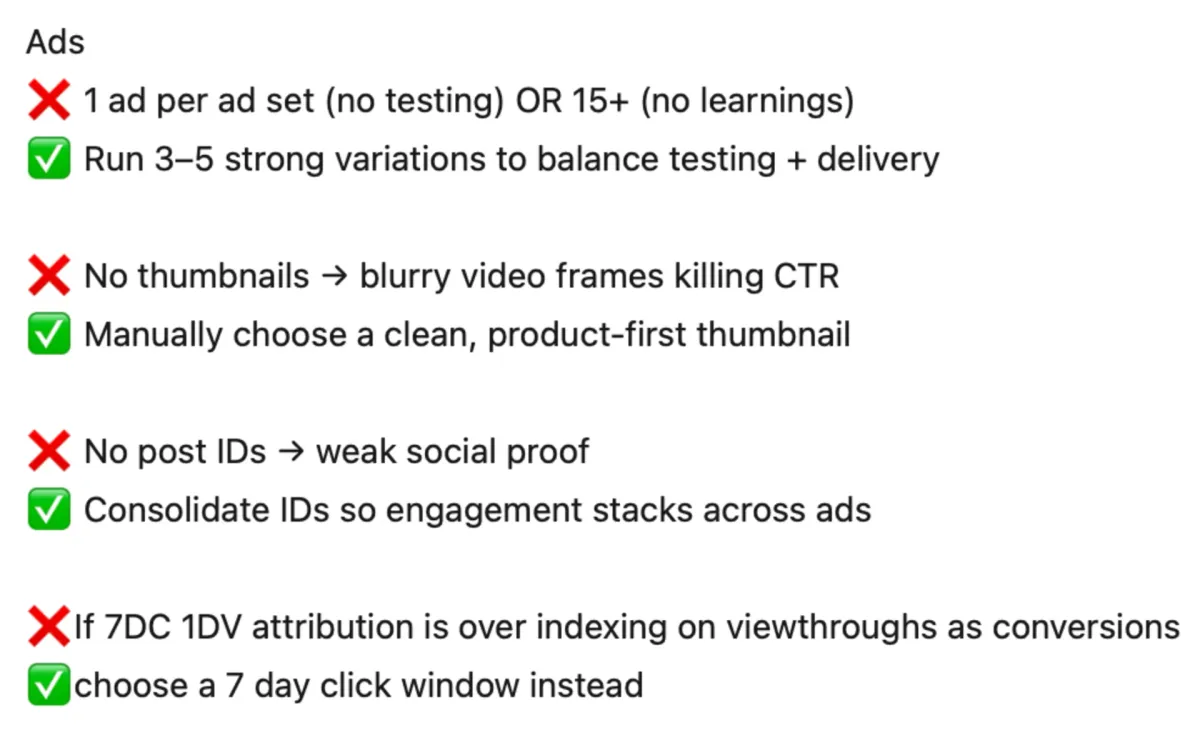
One of the most frequent issues Ho identifies is poor campaign structure. Advertisers often adopt one of two ineffective extremes: running only a single ad per ad set or overcrowding an ad set with more than 15 creatives. The former prevents meaningful testing, while the latter fragments performance data, making it difficult to identify successful elements.
“Run 3–5 strong variations to balance testing and delivery,” Ho advises. This range allows for adequate performance comparison without overwhelming the learning algorithm.
Neglecting Visual Content Quality
Another widespread problem is neglecting to manually select ad thumbnails. Many campaigns rely on auto-generated frames, which often appear blurry or unprofessional. This oversight negatively affects click-through rates and overall engagement.
To counteract this, Ho recommends choosing clean, product-focused thumbnails. “Professional, intentional visuals drive better engagement,” he notes, emphasizing that thumbnail quality can significantly influence campaign success.
Overlooking Social Proof Consolidation
Marketers often ignore the importance of consolidating post IDs across ad variations. Without this, engagement metrics like likes, comments, and shares remain fragmented, weakening the perceived popularity of each ad.
“Consolidate IDs so engagement stacks across ads,” Ho suggests, explaining that this simple tactic can amplify social proof and enhance campaign credibility.
Misconfigured Attribution Windows
Attribution settings frequently contribute to skewed performance data. Many campaigns default to a seven-day click, one-day view attribution model, which overemphasizes view-through conversions and misguides optimization efforts.
This can create a feedback loop where campaigns optimize for users who saw, but didn’t necessarily engage with, the ad. Ho recommends switching to a seven-day click window to ensure that reported conversions reflect actual user intent.
Budget Allocation Inconsistencies
Ho’s audits also uncovered budget misalignment across audience segments. Often, high-performing segments receive too little funding, while less effective ones consume the majority of the budget. This imbalance limits campaign scalability and ROI.
“Shift spend toward what’s already converting at or below your CPL/CPA target,” Ho advises. Aligning spend with performance metrics ensures that effective strategies receive the support needed to scale.
Improper Use of Exclusion Lists
Customer list exclusions are another area where many advertisers fall short. These lists help maintain traffic quality, especially for new customer acquisition campaigns. However, inconsistent or incorrect application can compromise performance.
Systematic use of exclusions ensures that campaigns target fresh audiences rather than retargeting existing customers, which is particularly important when the objective is to expand reach.
Scaling Without Strategy
Even when campaigns perform well, many advertisers hesitate to scale. Ho notes that some campaigns delivering excellent results at low budgets remain capped, missing opportunities for broader impact.
“Increase budgets gradually by 20–30%,” he recommends. This approach allows algorithms to adjust without destabilizing performance, enabling sustainable growth while preserving efficiency.
Industry-Wide Implications
These recurring errors have far-reaching implications. Despite Meta’s evolving algorithms and automation tools, many marketers fail to implement basic best practices, resulting in widespread inefficiencies. Even seasoned teams managing multimillion-dollar budgets are not immune to these pitfalls.
The cumulative effect of these mistakes is substantial. Campaigns with structural flaws underperform regardless of creative quality or strategic sophistication. Addressing these foundational issues can unlock immediate improvements, often without the need for major overhauls.
Implementation and Monitoring
Fixing these problems requires a methodical approach. Audits should be conducted regularly to identify and rectify issues. Changes should be implemented incrementally to preserve algorithmic learning and avoid performance disruptions.
Documenting adjustments and monitoring results are essential for refining optimization strategies. A strong foundation enables more advanced tactics to succeed, making basic operational excellence the cornerstone of high-performing Meta advertising campaigns.
Conclusion
John Ho’s analysis offers a roadmap for improving Meta ad performance through practical, data-driven strategies. By addressing common mistakes in structure, attribution, budget, and scaling, marketers can enhance campaign efficiency and return on investment across all business types.
This article is inspired by content from Original Source. It has been rephrased for originality. Images are credited to the original source.