

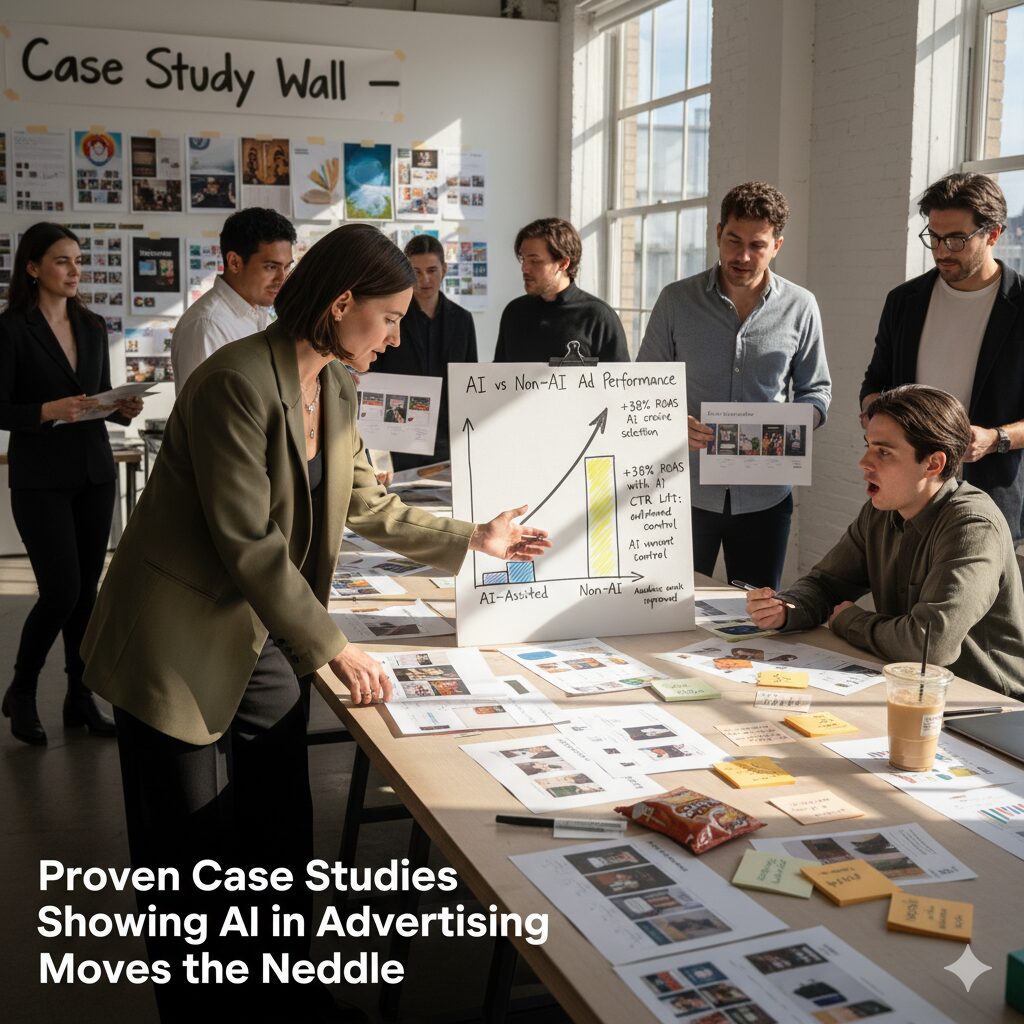
AI in Advertising: Transforming Campaign Performance
Artificial Intelligence (AI) is revolutionizing advertising, delivering measurable performance improvements across industries. With over 37% of marketing professionals actively using generative AI, the landscape is shifting rapidly toward more efficient, creative, and data-driven campaigns. Real-world case studies show how brands are embracing AI to scale content, identify high-intent audiences, and optimize campaigns in real-time.
Monks and Hatch: Scaling Personalization with AI
Monks, a digital agency, collaborated with Hatch—a wellness brand—to introduce the Restore 2 device to new audiences. The product required education-driven marketing tailored to specific personas, a challenge both costly and time-consuming using traditional methods.
To solve this, Monks employed an end-to-end AI pipeline. Google’s Gemini AI helped generate in-depth personas by simulating real-world preferences and behaviors. These personas guided the creative concept of Restore 2 as “the everything machine” for better sleep and daily performance.
Using Monks.Flow, their proprietary AI system, the team produced dozens of lifestyle-driven images and videos aligned with Hatch’s branding. AI also created custom soundscapes and text variations, enabling Google’s Performance Max to dynamically serve the most relevant content.
Results: Three personas, three videos, and sixty ad variants were delivered at half the production time and 97% lower cost. Campaign performance soared with a 31% drop in cost-per-purchase, 80% increase in click-through rates, and 46% rise in on-site engagement.
Marcel and Lidl: User-Generated AI Content at Scale
Marcel, part of Publicis, partnered with Bria to power a unique campaign for Lidl France. Their goal? Let customers generate branded visuals using AI—without compromising brand integrity or compliance.
They built a web app using Bria’s custom-trained Text2Image models, which converted user prompts into Lidl-themed visuals. The system supported multiple languages, ensured copyright-safe generation, and maintained brand consistency across millions of images.
With embedded moderation and attribution layers, user-generated content remained ethical and traceable. Influencer activation helped the campaign go viral, turning the app into a social media sensation.
Results: Over 1.7 million visuals were generated in three weeks. The campaign achieved high engagement, cultural relevance, and brand safety—all at scale.
Realtime and Liforme: AI-Powered Performance Testing
Realtime Agency tested Meta’s Advantage+ Shopping Campaigns (ASC) for Liforme, a brand with an already strong mid-funnel strategy. The aim was to see if AI could outperform existing setups by automating targeting and creative delivery.
Using Meta’s holdout testing, one region received ASC’s AI automation, while another retained the traditional structure. No creatives or budgets were changed—just the campaign structure and delivery method.
Results: ASC outperformed traditional campaigns by 67% in cost per purchase. Nearly all conversions came from new customers, proving AI’s strength in uncovering untapped audiences and optimizing delivery.
Karaca and SMEC: AI-Driven E-commerce Optimization
Turkish homeware brand Karaca faced challenges managing over 2,000 SKUs via Performance Max campaigns. Manual segmentation by category limited scalability and efficiency. Partnering with SMEC, Karaca restructured its campaigns using AI-powered performance tiers.
Products were dynamically assigned to High, Mid, or Low score campaigns based on real-time performance. SMEC’s platform automated budget allocation, excluded underperformers, and enabled seasonal bid strategies. Close collaboration ensured seamless integration with Google Merchant Center.
Results: From May 2024 to February 2025, Karaca saw a 44% ROAS increase and 31% revenue growth. The shift from manual to AI-powered optimization transformed their campaign strategy.
Omneky and New Sapience: Crowdfunding with AI Precision
New Sapience, a tech startup, turned to Omneky for their RegCF crowdfunding campaign. The goal was to explain a complex AI product and drive investment. Omneky used a three-part AI workflow: image generation, predictive scoring, and continuous optimization.
AI systems created ad visuals tailored to investor preferences, analyzed campaign performance, and refined placements in real time. Targeting focused on those likely to invest in AI and tech innovation.
Results: Over $460,000 was raised directly via ads, contributing to a $1.18 million total raise. With a 6x ROAS and over 52,000 link clicks, the campaign proved how AI can turn abstract ideas into compelling investment narratives.
How AI Is Reshaping Advertising
AI is no longer optional—it’s critical. From creative production to targeting and performance optimization, AI enhances every layer of advertising. Key benefits include:
- Creative Acceleration: Generates high-quality visuals in hours, not weeks.
- Smarter Targeting: Identifies high-intent users beyond demographic limits.
- Real-Time Optimization: Automatically reallocates budgets and suppresses low performers.
- Predictive Intelligence: Guides creative direction and reduces testing waste.
- Brand Safety: Ensures on-brand, copyright-safe content at scale.
These advantages are not theoretical—they’re proven across industries, from wellness to e-commerce and technology.
The Future of Advertising: Human Insight Meets Machine Precision
AI’s real power lies in amplifying human creativity rather than replacing it. By handling scale, speed, and data, AI frees marketers to focus on strategy and storytelling. From Lidl’s viral user content to Liforme’s precision testing, the winning formula is clear: combine human vision with AI execution.
Businesses that adopt AI today are not just improving performance—they’re defining the future of advertising.
This article is inspired by content from Original Source. It has been rephrased for originality. Images are credited to the original source.