

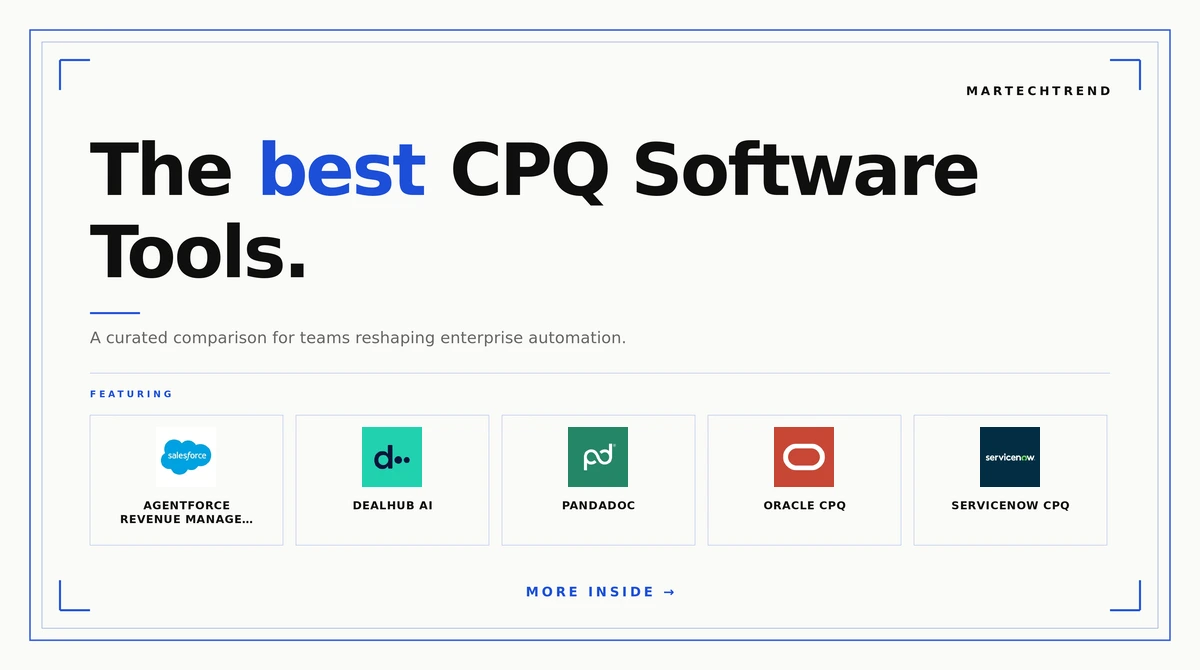
Choosing the right CPQ software is crucial for teams managing complex product configurations, pricing rules, and quotes. In this roundup, we evaluated leading CPQ solutions for 2026 to help you find the best fit for your sales and revenue operations needs.
After putting these best CPQ tools through their paces, we discovered that the strongest platforms unite pricing governance with speed, allowing sales reps to close deals faster while finance teams maintain control over discounts and approval workflows. Let’s dive into the top options.
How We Picked
We reviewed publicly available data, vendor documentation, and real-world deployment patterns across enterprise and mid-market CPQ deployments. Our selection focuses on tools that consistently earn trust from revenue operations teams, reduce quoting errors, integrate cleanly with CRM and billing platforms, and deliver measurable improvements in sales cycle time and margin protection.
 | 1. Agentforce Revenue Management (formerly Salesforce Revenue Cloud) |
Website: https://www.salesforce.com
Agentforce Revenue Management is Salesforce’s unified quote-to-cash backbone. It orchestrates product configuration, pricing, approvals, contracts, billing, and revenue recognition all within the Salesforce ecosystem. For organizations already invested in Salesforce, this is the platform that eliminates handoffs and keeps data synchronized across sales, finance, and operations. The strength lies in its native integration with the entire Salesforce stack – no custom connectors required, just trusted data flow.
Content Capabilities:
- Advanced product configuration with dependency rules and constraints
- Dynamic pricing with discount approvals and policy guardrails
- Subscription and usage-based billing models
- Revenue recognition automation (ASC 606 and IFRS 15 compliant)
Best for: Enterprises with complex product catalogs and subscription revenue models that live on Salesforce.
 | 2. DealHub AI |
Website: https://www.dealhub.ai
DealHub AI is a modern quote-to-cash platform built for SaaS and B2B companies that need to move fast. What makes it different is its emphasis on guided selling paired with deep CRM integration. The platform lets you deploy multiple monetization models – from sales-led to product-led to self-serve – on a single foundation. Teams love DealHub for its intuitive interface, rapid onboarding, and the fact that your pricing logic stays synchronized with your CRM data without constant manual interventions.
Content Capabilities:
- Guided CPQ with interactive product configuration
- Multi-model monetization (SLG, PLG, self-serve, subscription, usage-based)
- AI-native contract and deal room workflows
- Real-time ARR and revenue dashboards
Best for: Growth-stage SaaS companies managing multiple sales channels and pricing experiments.
 | 3. PandaDoc |
Website: https://www.pandadoc.com
PandaDoc is the go-to for teams that need a unified document experience. While it includes CPQ capabilities, its real strength is marrying quoting with e-signature, contract assembly, and payment capture in one place. Rather than bouncing between tools, your sales reps draft proposals, gather signatures, and close payments without context switching. The platform has earned trust across legal, sales, and operations teams who care equally about speed and compliance.
Content Capabilities:
- Drag-and-drop proposal and quote design
- Legally binding e-signatures natively integrated
- Automated document routing and approval workflows
- Payment capture and document analytics
Best for: Teams selling services or custom solutions who need to move from quote to signed agreement in one unified workflow.
 | 4. Oracle CPQ |
Website: https://www.oracle.com
Oracle CPQ (formerly BigMachines) brings enterprise-grade product configuration and guided selling to complex sales environments. It excels at handling deeply modular product architectures and rule-heavy pricing scenarios. The platform’s strength is its ability to enforce product constraints, drive guided selling flows, and translate complex configurations into structured orders. Finance teams appreciate how it closes the loop between quote and fulfillment without requiring downstream rework.
Content Capabilities:
- Advanced product configuration with hierarchical structures
- Guided selling with context-aware recommendations
- Complex discount and approval rule automation
- Omnichannel quote generation (web, mobile, assisted sales)
Best for: Manufacturing and complex B2B organizations with multi-dimensional product hierarchies and strict configuration constraints.
 | 5. ServiceNow CPQ |
Website: https://www.servicenow.com
ServiceNow CPQ is an API-first, composable quoting platform built for enterprises already running on ServiceNow’s platform. It emphasizes flexibility and real-time configuration, letting you adjust logic and workflows without lengthy deploy cycles. The platform’s advantage is how it bridges traditional enterprise software governance with modern, rapid iteration – you can run guided selling flows one day, pivot your pricing model the next, all without a heavy hand.
Content Capabilities:
- API-first architecture for flexible integrations
- Dynamic product discovery and configuration
- Centralized transaction management across channels
- Intelligent pricing and offer recommendations
Best for: Large enterprises already invested in ServiceNow who value flexibility and rapid pricing iteration.
 | 6. Conga CPQ |
Website: https://conga.com
Conga CPQ is built from the ground up as a Salesforce native solution. The platform unifies configuration, pricing, contracts, billing, and renewals into a single data model inside Salesforce, eliminating silos between sales, finance, legal, and operations. Where we found Conga shines is in its intuitive product configuration UI and its ability to handle the full quote-to-cash lifecycle without breaking out of Salesforce. Teams report faster implementations than enterprise alternatives and fewer integration headaches.
Content Capabilities:
- Native Salesforce CPQ and contract management
- Intuitive product configuration interface
- Integrated billing and renewal automation
- Full visibility into pricing risks and opportunities
Best for: Salesforce-native teams selling complex products who need unified quoting and contract lifecycle management.
 | 7. Qwilr |
Website: https://qwilr.com
Qwilr modernizes the proposal experience. Instead of static PDF quotes, it transforms your offers into interactive, web-based documents that engage buyers and track behavior in real-time. Sales teams can embed videos, dynamic pricing calculators, and contract signing – all tracked with precise engagement analytics. The platform emphasizes buyer experience and rep efficiency in equal measure, letting you know exactly which sections prospects review and when they’re ready to commit.
Content Capabilities:
- Interactive web-based proposal design
- Real-time engagement tracking and buyer signals
- Integrated e-signatures and payment collection
- CRM automation for follow-ups based on engagement
Best for: Sales teams focused on buyer experience, engagement tracking, and shorter sales cycles.
 | 8. SAP CPQ |
Website: https://www.sap.com
SAP CPQ (CallidusCloud) is a mature platform designed for global enterprises with complex, multi-region product offerings. It handles advanced configuration logic, multi-currency pricing, and localized approval workflows across the world. The platform’s strength is its ability to enforce compliance and governance at scale while keeping configuration flexible enough for business experimentation. It works best when treated as a strategic piece of the revenue operations infrastructure, not just a quoting tool.
Content Capabilities:
- Enterprise product configuration and constraint management
- Multi-currency and multi-region pricing
- Complex approval hierarchies and compliance workflows
- Mobile quoting for field and partner sales
Best for: Global enterprises with regulated pricing, complex channel strategies, and deep ERP integration needs.
Final Thoughts on Best CPQ Software
The best CPQ software for your organization depends on where you sit – are you a Salesforce shop, a ServiceNow shop, or do you need a platform-agnostic solution? Are you focused on speed and simplicity, or do you need to handle deeply complex product configurations? The platforms we reviewed all excel, but they excel in different contexts. Start with your ecosystem, define the complexity you need to solve, and pilot with a small team before rolling out company-wide. CPQ success is as much about governance and process clarity as it is about tool capability.
Manage Your Way Into Coverage
Finding the right CPQ solution requires understanding your pricing complexity, sales velocity, and integration needs. Evaluate platforms with your revenue operations team first, not your IT team. Let your revenue team drive the selection – they’ll live with it daily and know best whether a tool scales with your business.
Frequently Asked Questions
What is CPQ software?
CPQ software automates the process of configuring products, applying pricing rules, and generating accurate quotes. It streamlines complex sales operations and reduces quoting errors by keeping pricing logic synchronized with your CRM and backend systems.
How much does CPQ software cost?
CPQ pricing ranges from $50-500+ per user monthly depending on complexity and features. Most platforms charge per seat, though some offer tiered pricing based on quote volume. Most vendors offer free trials so you can test before committing.
Is there free CPQ software?
Some platforms like Qwilr and Proposify offer limited free versions for small teams, but enterprise-grade CPQ typically requires paid plans. Free versions usually include basic quoting but lack advanced configuration and approval workflows.
How do I choose the best CPQ software?
Start by mapping your product complexity, pricing rules, and approval workflows. Evaluate how tools integrate with your CRM and ERP systems. Pilot with your revenue operations team first – they’ll know best whether the platform scales with your business needs.