

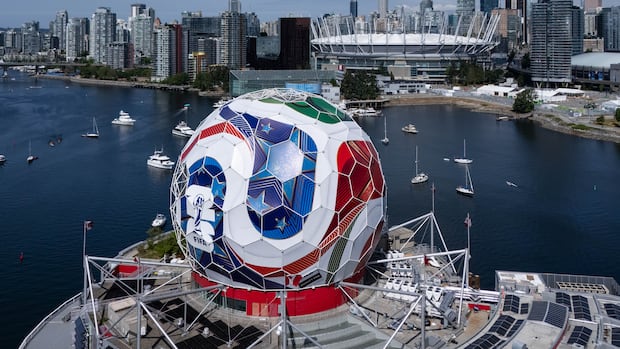
Science World’s Dome Transforms for FIFA World Cup 2026
The Science World soccer ball installation in Vancouver has become a viral sensation during the FIFA World Cup 2026, drawing attention not only for its striking visuals but also for the prominent Adidas and FIFA branding it displays—despite neither organization paying for the project. As the city revels in its moment on the global stage, questions arise about brand exposure, marketing strategy, and who truly benefits from this innovative display.
The Story Behind the Giant Soccer Ball
The iconic geodesic dome of Science World has been wrapped to resemble the official Adidas Trionda ball, the centerpiece of the World Cup. While the dome now sports both Adidas and FIFA logos, neither company contributed financially to this ambitious project. Instead, Science World, Destination Vancouver, the City of Vancouver, the Province of British Columbia, and the Vancouver Hotel Destination Association collaborated to fund what has quickly become one of the most talked-about marketing stunts of the tournament.
According to Science World, both Adidas Canada and FIFA gave permission for their branding to be used on the installation, titled the “Beautiful Dome.” However, the transformation has essentially turned the dome into a gigantic, three-dimensional advertisement for both brands at no direct cost to them.
Who Paid for the Installation?
Destination Vancouver is the primary funder, though specific costs remain undisclosed due to a confidentiality agreement. Royce Chwin, CEO of Destination Vancouver, emphasized that taxpayer impact was minimal, highlighting that their funding does not come from taxpayers. The Province of British Columbia did contribute $150,000, according to the Ministry of Tourism, Arts, Culture and Sport.
The ministry described the project as a reimagining of one of Vancouver’s most recognizable landmarks, positioning the city as a symbol at the center of the world’s biggest sporting event. The Science World soccer ball installation has already appeared in international broadcasts and is widely shared on social media, amplifying its marketing reach far beyond Vancouver.
Marketing Experts Weigh In
Trina Notman, a Vancouver branding and marketing expert, considers the Science World soccer ball the most creative marketing execution among all 16 World Cup host cities. “The real star isn’t the Adidas logo—it’s the Vancouver skyline and the iconic Science World landmark,” Notman explains. She argues that the installation’s success lies in fusing a global sports symbol with a local architectural icon, making it highly shareable and memorable.
For comparison, Seattle, another World Cup host city, painted its Space Needle roof to resemble a soccer ball—but opted for a generic design rather than official branding. The global impact of Vancouver’s approach is already evident: a Reuters photo of the Beautiful Dome has been picked up by over 100 media outlets, and Notman predicts it could reach 100 million impressions before the World Cup concludes.
Adidas, FIFA, and the Value of Free Exposure
Despite receiving prominent exposure, both Adidas and FIFA provided only their approval for logo use, not financial support. Jessie Adcock, head of Vancouver’s World Cup organizing committee, noted that commercial affiliates like Adidas must balance their investments across 16 host cities. While Adidas might not have contributed directly to the Science World soccer ball, the company remains active in other support roles for the tournament.
Adidas, the world’s second-largest sportswear manufacturer, reported over $28 billion in revenue last year. FIFA expects $13 billion from the 2026 World Cup alone. The Science World non-profit continues to receive government support for its broader mission, with significant investments from both city and province for maintenance and repairs in recent years.
The Economic Impact and Lasting Legacy
Hosting seven World Cup games in Vancouver is projected to cost around $729 million, or $104 million per game, with a predicted net taxpayer impact of $114 million after offsetting revenues. Provincial forecasts suggest the event could bring one million additional visitors and generate $1 billion in GDP for British Columbia by 2031, although some experts remain skeptical of these projections.
While the economic benefits are still debated, the Science World soccer ball has undeniably succeeded in placing Vancouver in the international spotlight, showcasing how creative marketing and iconic landmarks can combine for maximum impact during global events.
Conclusion: A Win for Creative Marketing?
The Science World soccer ball installation demonstrates the power of creative, city-scale marketing in the digital age. With millions captivated by the imagery and international brands enjoying massive free exposure, Vancouver’s approach has set a new standard for event marketing. Whether it’s a marketing genius or an own goal, the fusion of local culture and global sport has made the Science World soccer ball a defining image of the 2026 World Cup.
This article is inspired by content from Original Source. It has been rephrased for originality. Images are credited to the original source.