

AI Ad Platforms and Marketing Budget Challenges
AI ad platforms have revolutionized digital marketing, but recent insights from Silverback Strategies CEO Neil Welsh highlight a growing problem: these platforms are increasingly draining marketing budgets without delivering corresponding business results. Speaking at the Senior Living Executive Conference (SLEC) 2026, Welsh detailed how marketing leaders, particularly in the senior living sector, are struggling to achieve occupancy growth despite significant investments in paid media managed by AI systems.
Why AI Campaigns Are Stalling Growth
According to Welsh, AI ad platforms such as Google Smart Bidding, Meta Advantage+, and Google Performance Max have steadily taken over critical campaign elements like targeting, bidding, and budget allocation. While this automation promises efficiency, it often diverts ad spend toward sources that don’t drive true incremental growth. Welsh explained that many senior living operators are pouring more money into AI-managed paid media, only to see conversions that would likely have happened regardless of the ad spend.
The real risk isn’t limited to senior living. Welsh noted that these budget-draining patterns are prevalent across various industries. The heart of the issue is that AI ad platforms optimize for signals that may not align with meaningful business outcomes, leading advertisers to pay for conversions that add little value.
The Three Patterns Behind Budget Waste
Welsh identified three primary drivers of wasted ad spend:
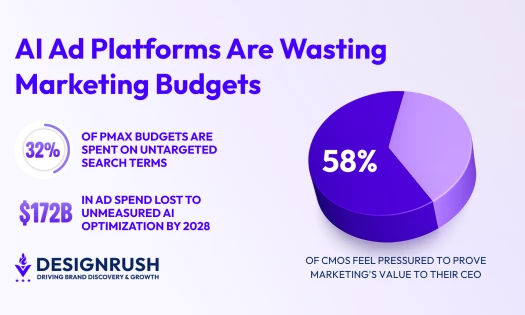
- Bot Traffic and Fake Conversions: AI-driven campaigns rely on conversion data, but some of that data comes from fraudulent activity. Juniper Research estimates that digital ad fraud cost $84 billion in 2023, projected to reach $172 billion by 2028. When platforms optimize for fake conversions, they inadvertently funnel more budget into low-value or fraudulent sources.
- Non-Incremental Branded Search: A significant portion of budget—about 32% for Performance Max campaigns—is spent on branded search terms. Often, these are searches from users already planning to convert, meaning advertisers pay for conversions that would have happened anyway.
- Poor Optimization Signals: Platforms that focus on metrics like clicks and form fills may optimize for those actions, but in industries like senior living, a form fill doesn’t necessarily translate to a move-in. This results in reports that look impressive on the surface, yet fail to reflect true business progress.
Real-World Data: The Incrementality Gap
Welsh shared an eye-opening case study from one of Silverback Strategies’ clients. The agency discovered that while platform reports showed a cost per acquisition (CPA) of $212 for branded search, the true incremental CPA—measured through rigorous incrementality testing—was $1,059. That’s nearly five times higher than what the platform reported. Conversely, a Demand Gen campaign reported a high CPA of $579, making it a candidate for cuts, but its real incremental CPA was just $157, suggesting it was actually more effective than perceived.
This disconnect between platform data and actual business value is a key reason why AI ad platforms can mislead marketers and waste valuable budget.
Immediate Steps to Fix Paid Media Waste
Despite these challenges, Welsh is optimistic. He offered a practical 30-day fix that brands and agencies can implement to reclaim wasted spend and ensure their AI ad campaigns drive real results:
- Eliminate Waste: Use brand exclusions in Performance Max, turn off search partners, and invest in bot detection to prevent budget from flowing to low-value conversions.
- Optimize for the Right Outcomes: Integrate your CRM and offline conversion tracking, and implement a Conversion API. This enables platforms to optimize for meaningful events, like actual customer move-ins, rather than superficial metrics.
- Test for Incremental Growth: Run incrementality testing and media mix modeling to distinguish between campaigns that create new demand and those that merely claim credit for existing conversions.
The Importance of Signal Discipline
As AI ad platforms grow more autonomous, they require vigilant oversight. Marketers must ensure that the signals and conversion data they provide accurately reflect desired business outcomes. Welsh emphasized the need for ongoing incrementality testing and disciplined signal management to prevent platforms from optimizing for the wrong outcomes.
Failing to do so risks scaling ineffective channels, draining budgets, and undermining long-term growth. Marketers who master these strategies will be better positioned to make the most of their investments in AI-powered advertising, even as platforms become more complex and opaque.
This article is inspired by content from Original Source. It has been rephrased for originality. Images are credited to the original source.