

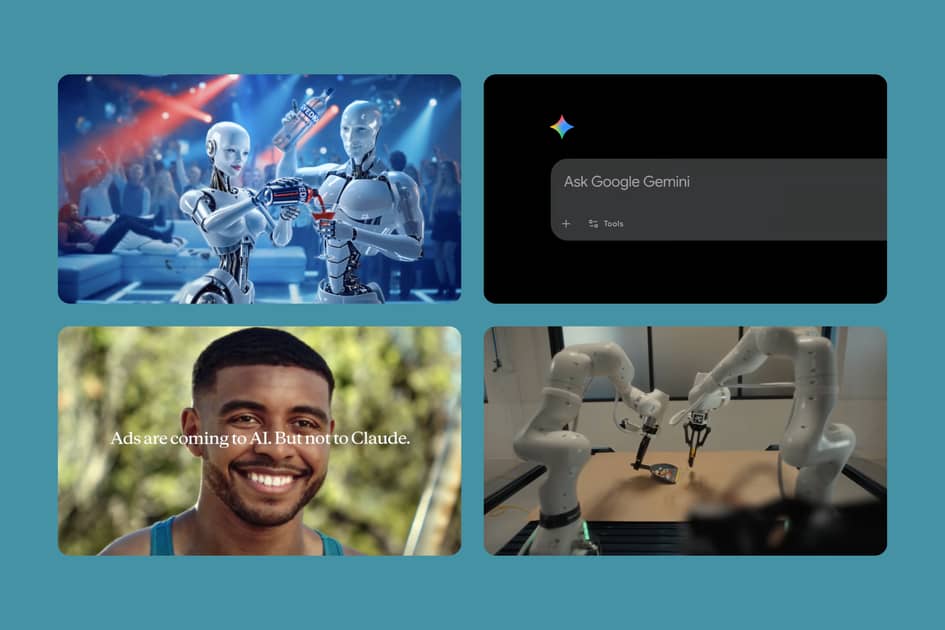
The Rise of the ‘AI Bowl’
During this year’s Super Bowl, it wasn’t just the football game that had people talking—it was the commercials. In a trend reminiscent of past events like the 2022 Crypto Bowl and the 2000 Dot Com Bowl, one industry dominated the airwaves: artificial intelligence. Out of 66 total commercials aired, 15 were either created by AI companies or featured AI tools, according to data from iSpot. This influx has led many to dub the event the ‘AI Bowl.’
The advertisements varied widely in tone and message. Some, like Amazon’s Alexa+ spot featuring Chris Hemsworth, leaned into dystopian humor, playing on fears of AI overreach. Others, such as those from OpenAI, Google Gemini, Ring, Meta, and Oakley, highlighted AI’s capabilities to enhance daily tasks. Brands like Microsoft Copilot, Genspark, Wix, and Base44 focused on AI’s ability to reduce workloads. Meanwhile, companies like Anthropic and AI.com looked ahead, showcasing visions of the future of AI in marketing and agentic technology.
Challenges of Differentiation and Market Saturation
Experts note that the variety in messaging reflects a broader issue: the challenge of standing out in a rapidly growing and crowded market. “It becomes a classic marketing problem of differentiation,” said Derek Rucker, a marketing professor at Northwestern University’s Kellogg School of Management. “Which product do I use and why?” He added that it’s natural for AI companies to turn to high-profile venues like the Super Bowl to gain visibility.
Allen Adamson, co-founder of brand consultancy Metaforce, echoed this sentiment. He emphasized that these companies are now expected to deliver real-world results. “Everyone understands that AI has a lot of potential, but now it’s time to start seeing what that potential is beyond company valuation levels,” Adamson said.
Consumer Sentiment: A Tough Crowd
Despite the high-profile placements, consumers were not entirely receptive. Analytics firm Meltwater found that nearly 50% of mentions regarding AI ads were negative, suggesting a broader skepticism toward the flood of AI-related content. Some viewers even described the ads as evidence of “declining creative effort.”
Interestingly, AI ads only constituted 6% of total ad mentions and 4% of engagement, indicating that while the ads were numerous, they didn’t dominate public discourse. Rucker suggested this may reflect consumer fatigue: “When you start seeing more ads in a category, people begin to feel oversaturated—‘Do we have to see another one?’”
Anthropic vs. OpenAI: A New Brand Rivalry
This year’s Super Bowl also introduced a new rivalry in the tech advertising space. Anthropic, the company behind Chatbot Claude, launched a campaign with four commercials that took direct aim at OpenAI’s advertising model. The tagline “Ads are coming to AI. But not to Claude” took a clear shot at OpenAI’s recent ad testing on ChatGPT.
Another spot from Anthropic stated, “There is a time and place for ads. Your conversations with AI should not be one of them.” The campaign was designed to build momentum across the spots, offering a layered messaging strategy.
OpenAI responded swiftly. Chief Marketing Officer Kate Rouch acknowledged that the Anthropic spots were “effective” and “funny,” but labeled them “untrue.” The back-and-forth generated substantial buzz. According to PeakMetrics, there were over 151,000 ChatGPT mentions and 69,000 Claude mentions on X (formerly Twitter). Remarkably, Claude’s campaign achieved double the penetration relative to its brand size.
Despite the increased visibility, PeakMetrics noted that Anthropic’s message may not have resonated as broadly. The ads required an understanding of OpenAI’s plans to include advertising, whereas OpenAI’s messaging leaned more into inspiration and broader appeal.
“The origin of the work wasn’t about advertising, it was about what people want from this technology,” wrote Andrew Stirk, Anthropic’s head of brand marketing, in a LinkedIn post explaining the campaign’s intent.
Viral Hoaxes and Misinformation
The drama didn’t stop with brand rivalries. Leading up to the game, a viral video featuring actor Alexander Skarsgård, shown using earbuds and a futuristic orb, sparked speculation that it was part of a new AI hardware campaign from OpenAI. A fake Ad Age headline added fuel to the fire. However, this turned out to be a hoax.
OpenAI confirmed to Marketing Brew that the video had no connection to the company. Despite the confusion, OpenAI spokesperson Lindsay McCallum Rémy verified that the footage was indeed real and featured Skarsgård, though its origins remain unclear.
As AI continues to evolve and become more integrated into mainstream culture, the reactions—both positive and negative—underscore the industry’s growing pains. Whether it’s through high-budget Super Bowl ads or viral internet content, AI companies are learning that public perception can be as challenging to manage as the technology itself.
This article is inspired by content from Original Source. It has been rephrased for originality. Images are credited to the original source.