

Taylor Swift’s Wedding Ignites a Marketing Frenzy
Taylor Swift’s highly anticipated wedding to Travis Kelce transformed into a viral celebrity event marketing showcase, with brands both big and small leveraging the moment to boost their own visibility. From playful social media stunts to highly coordinated digital ad campaigns, the buzz surrounding the celebrity nuptials became a prime example of how brands capitalize on real-time cultural moments. Celebrity event marketing was front and center as businesses sought to connect with the massive audience following the wedding.
Billboards, Social Media, and Swift-Inspired Campaigns
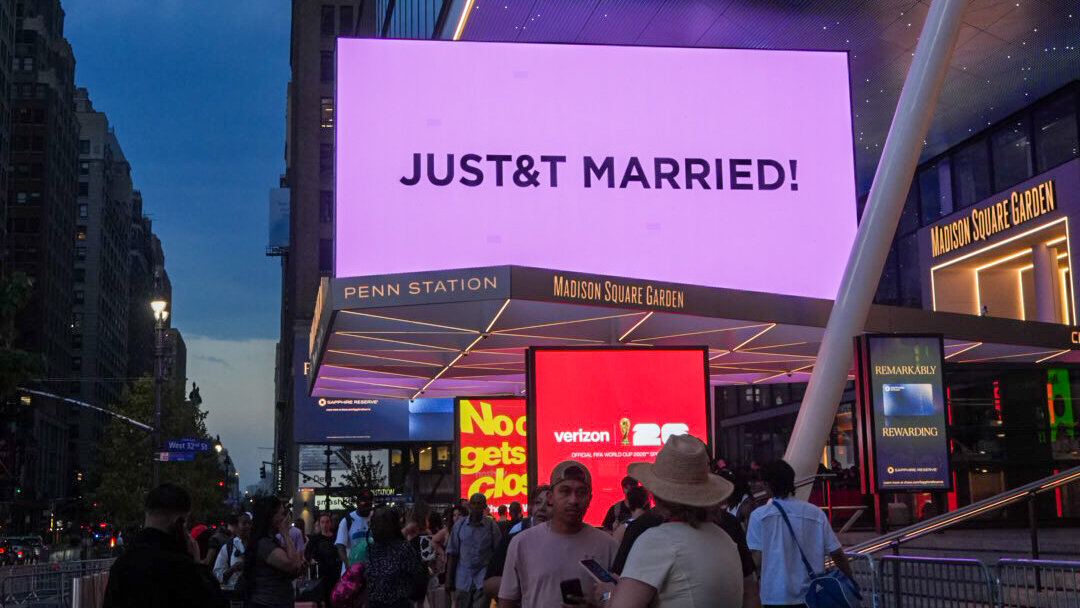
On the evening of July 3rd, the iconic Madison Square Garden lit up with a purple “JUST&T MARRIED!” message outside its doors. While some speculated whether the sign was an ad for a telecommunications company, it was soon confirmed as a congratulatory nod to Taylor Swift and Travis Kelce. The timing was no accident. The Knot Worldwide, a leader in wedding planning technology, quickly deployed four digital billboard trucks in the area, flashing messages like “make your wedding the main event” and “cheers to the happy couple.” These efforts turned the spotlight on their brand by associating with the year’s most talked-about wedding, a textbook case of celebrity event marketing.
Casey Moujaes, vice president of global vendor marketing at The Knot, explained, “Once we had confidence in N.Y.C. and M.S.G. as the likely venue, we mobilized quickly.” Their speedy action secured valuable real estate near the arena, ensuring their brand was visible during the wedding’s peak attention window.
Brands Find Creative Ways to Join the Conversation
Other brands weren’t far behind in the celebrity event marketing race. The Barclays Center posted a clever graphic on Instagram: “Ready to Tie the Knot?” inviting couples to book their own private events. Sephora, meanwhile, tapped into Swift’s signature style, playfully asking fans on Threads and Instagram, “But is she wearing a red lip to the wedding?” These subtle nods allowed brands to participate in the conversation without overstepping, demonstrating the power of cultural relevance in digital marketing.
In the age of AI-generated content, it was inevitable that the imagery surrounding the wedding would be repurposed. The White House social media account, for example, humorously altered the Madison Square Garden billboard in its own messaging, showcasing how viral moments can be adapted for different agendas.
AI-Generated Content and the Risks of Manufactured Relevance
For small businesses, celebrity event marketing offered both opportunities and pitfalls. Marielle Conlon, owner of Ocean Road Antiques in Pennsylvania, created an AI-generated video showing her bamboo-lacquered furnishings being delivered to Madison Square Garden, jokingly implying her involvement in the wedding. “Because I, like other small businesses, don’t have a large advertising budget, I try to be creative with my marketing,” Conlon shared. Her reel quickly gained traction, earning over 11,000 likes and 1,500 shares, though it also sparked debates about authenticity.
Public relations expert Ariane Lovell cautioned, “If your brand wasn’t part of the moment, don’t try to rewrite history with A.I. Consumers are increasingly savvy now. We can spot when a brand is manufacturing relevance instead of earning it.” This highlights a crucial consideration for brands engaging in celebrity event marketing: genuine participation trumps forced associations.
Legal and Ethical Boundaries in Event-Based Marketing
Legal experts suggest that playful exaggeration—such as Conlon’s tongue-in-cheek video—generally falls under the category of “puffery” rather than deceptive advertising. Andrew B. Jacobs of Winston Taylor LLP clarified, “If the image or statement merely conveys excitement or aspiration, it is more likely puffery, which is an exaggerated or boastful statement of opinion that no reasonable person would rely upon as a factual representation.”
Despite the viral attention, Conlon admitted the campaign didn’t result in a sales spike. “This wasn’t some wildly profitable marketing stunt,” she noted, underscoring that while buzz is valuable, it doesn’t always translate directly into revenue.
The Power and Limits of Celebrity Event Marketing
The spectacle surrounding Taylor Swift’s wedding demonstrates how celebrity event marketing can generate enormous attention for brands—if executed thoughtfully. Timely, relevant, and authentic content can help brands ride the wave of cultural moments, but marketers must be careful not to overreach or mislead audiences, especially in the era of AI-driven content.
This article is inspired by content from Original Source. It has been rephrased for originality. Images are credited to the original source.