

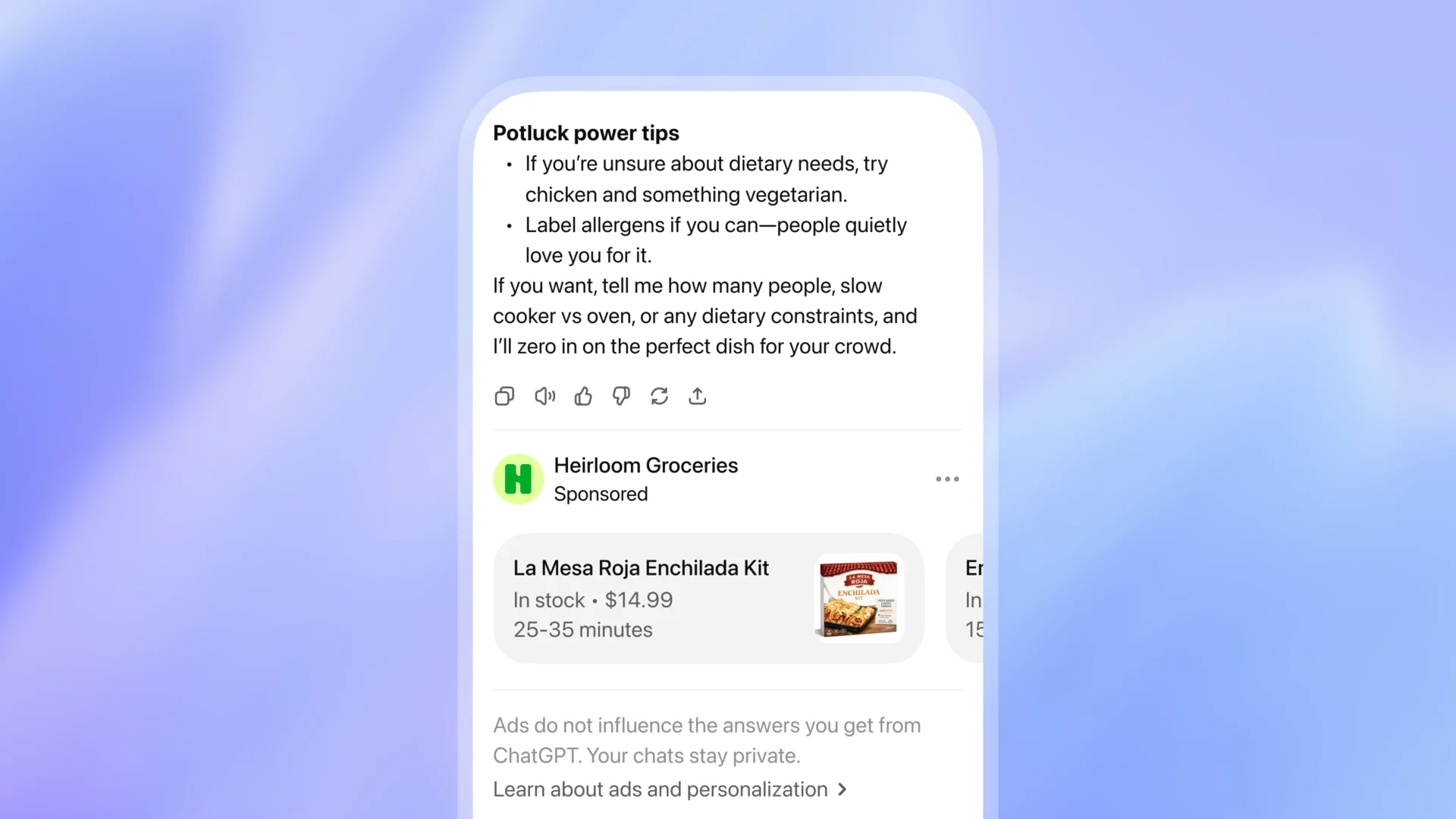
OpenAI Introduces Ads to ChatGPT: A New Era in Conversational AdTech
ChatGPT advertising is now a reality, as OpenAI launches ads within its AI-powered conversational platform. Marketers and industry analysts are closely watching how this bold move could reshape digital advertising, but many remain unconvinced about its immediate impact and data-driven capabilities.
From Brand-Led to Cost-Per-Click: OpenAI’s New Ad Model
OpenAI’s CEO once expressed a dislike for advertisements, yet the company has started rolling out ads on ChatGPT. Initially available to US users in February, the feature is now expanding to Canada, Australia, and New Zealand, with ambitions for broader global reach. The company’s shift from a cost-per-thousand (CPM) model to a cost-per-click (CPC) approach signals a strategy to attract more performance-oriented advertisers.
Early results are encouraging according to OpenAI, with a low dismissal rate for banner ads and no measurable drop in user trust. However, marketing professionals are divided. Some are excited by ChatGPT advertising’s potential reach—the platform boasts over 700 million weekly active users—but others are wary of its current limitations compared to established giants like Google and Meta.
Marketers Highlight Data and Functionality Gaps
Industry experts argue that while the platform’s reach is undeniable, its ad manager lacks the robust performance data and targeting capabilities of legacy platforms. Claire Holubowskyj, Senior Research Analyst at Enders Analysis, notes, “OpenAI’s ads manager currently lacks much of the functionality of established platforms, with limited visibility over performance, though this is improving quickly.”
Nicole Greene, VP Analyst at Gartner, agrees, highlighting that ChatGPT advertising relies mainly on conversation history and location, rather than the comprehensive demographic and behavioral data offered by Google Ads and Meta. Marketers also face a minimum spend commitment—recently lowered from $250,000 to $50,000—which remains high for many brands.
Other concerns include limited buying control, lack of traditional placement parameters, immature measurement tools, and unpredictable brand safety risks due to the dynamic nature of AI-powered conversations. Greene cautions that brands with strict content guidelines should approach ChatGPT advertising carefully until more advanced features are available.
Unique Creative Potential—But Is It Enough?
Despite its shortcomings, ChatGPT advertising offers a unique value proposition: banner ads are embedded directly into interactive dialogue, allowing for more contextual and less intrusive ad experiences. According to Greene, “The platform excels in contextual relevance, serving ads based on immediate conversational flow and user intent.” This format encourages brands to develop creative, dialogue-based campaigns, potentially transforming how high-consideration or information-rich products are marketed.
However, limitations persist. Heavy users are likely to be on ad-free subscription tiers, restricting the pool of users exposed to ads. Analysts suggest that unless OpenAI can successfully integrate advertising without disrupting the user experience, ChatGPT advertising may remain a supplementary channel within broader multi-channel strategies rather than a primary platform.
Experimentation Phase: Marketers Adopt a Test-and-Learn Approach
Given the current state of the platform, Gartner advises clients to treat ChatGPT advertising as a ‘test-and-learn’ channel rather than a replacement for established digital ad platforms. Greene points out that while Google’s dominance is rooted in vast user data and distribution, ChatGPT’s conversational ads offer a new way to engage consumers and should be viewed as an experimental opportunity.
For brands in high-consideration categories, conversational AI may provide a powerful tool to inform and influence purchasing decisions—if content is adapted for natural language and interactive prompts. Standard click-through metrics will need to evolve to measure dialogue engagement and follow-up interactions, signifying a shift towards ‘answer engine optimization’ (AEO) rather than traditional SEO.
Looking Ahead: Will ChatGPT Advertising Compete with Giants?
Experts remain cautious about ChatGPT advertising’s ability to rival Google or Meta in the near future. Significant improvements in measurement, targeting, and ad inventory are required for the platform to fulfill its promise. Holubowskyj notes, “It is still an unproven format, and lots of early interest will stem from curiosity, but this won’t last long without results.”
There is optimism that, over time, OpenAI could carve out a profitable niche in information-rich, high-consideration sectors—if it continues to refine its ad tools and address current shortcomings. For now, ChatGPT advertising represents a fascinating evolution in digital marketing, but its place alongside established platforms remains uncertain.
This article is inspired by content from Original Source. It has been rephrased for originality. Images are credited to the original source.