

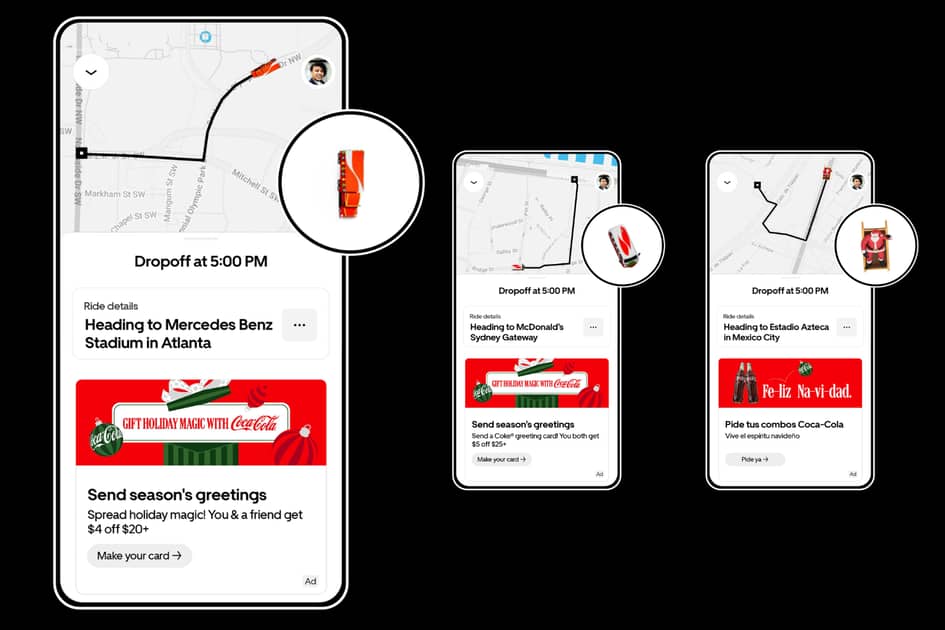
Uber Introduces New Ad Experience with Map Customization
Uber is expanding its advertising capabilities with a bold new feature that allows brands to customize the in-app map, one of the company’s most viewed elements. Known as Journey Takeovers, this initiative enables advertisers to create immersive brand experiences across the Uber ecosystem—including car tablets, the mobile app, and now, the navigation map itself.
“We’re covering every angle of where people are looking,” said Kristi Argyilan, Uber’s global head of advertising, during CES. “We already have, on average, about 20 minutes of someone’s attention when they’re in an Uber… now we’re actually connecting one of our most prized brand assets, which is the map.”
Creating Immersive Brand Journeys
The Journey Takeovers feature is designed to offer more than just ad impressions. It provides contextually relevant, location-based experiences that align with a rider’s destination and current events. During the 2025 holiday season, Coca-Cola became one of the first brands to pilot this new advertising format.
As part of its campaign, Coca-Cola collaborated with Uber’s in-house Creative Studio to develop customized map icons that resonated with local markets. Riders in Spain, Portugal, and the United States saw a Coca-Cola Christmas caravan. In Mexico, the icon appeared as Santa’s sleigh, while in Australia and New Zealand, it transformed into a branded Kombi van. These visual touches created a festive and personalized experience for riders based on their location.
From Static Ads to Dynamic Engagement
Uber has previously altered its map icons to reflect its own marketing efforts, such as turning the car icon into a Formula 1 vehicle during a racing event. But this marks the first time external brands are being given the opportunity to shape the user experience on such a granular level.
With the company’s ad network reaching a $1.5 billion annual revenue run rate by early 2025, Uber is poised to capitalize on its captive audience. Riders often spend extended periods staring at the map, making it a prime canvas for advertisers to create meaningful connections.
Beyond Metrics: Focusing on Experience
Argyilan emphasized that the goal isn’t just about traditional ad metrics like CPMs or reach. Instead, the focus is on delivering contextually rich moments that forge a deeper connection between consumers and brands. “We’re getting past this, ‘What’s the CPM? How many impressions? What’s the reach and frequency?’ to really understand, ‘How am I creating a contextually relevant moment between a consumer and my brand?’” she explained.
Advertisers interested in Journey Takeovers can expect pricing to vary depending on the scope and complexity of their campaigns. Custom creative elements and localized content will influence the overall cost, but the potential payoff is a more engaged and attentive audience.
Consumer Response and Marketplace Demand
According to Argyilan, early feedback suggests that consumers are more receptive to immersive digital experiences than traditional ads. “What we’re seeing from a consumer perspective is that people are not necessarily excited about ads as much as they are about experiences,” she said. “And this is one of very few digital experiences that can be this immersive.”
This shift in strategy reflects broader trends in the advertising industry, where brands are increasingly prioritizing engagement over exposure. By allowing advertisers to integrate seamlessly into a rider’s journey, Uber is positioning itself as a unique player in the ad tech space.
The Road Ahead for Uber Advertising
Journey Takeovers are just the latest in a series of moves by Uber to bolster its advertising platform. With the ability to reach riders during a highly attentive time, the company is tapping into an underutilized opportunity in the rideshare environment.
As Uber continues to refine this offering, it’s likely that more brands will be enticed by the prospect of customizing the in-app experience. Whether it’s through seasonal campaigns or event-based promotions, the potential for personalized, location-specific ads opens up new creative avenues for marketers.
With its growing ad revenue and innovative features, Uber is redefining what it means to advertise in motion. And as more brands jump on board, riders might soon find their journey filled with more than just a ride—they’ll be part of an interactive brand story.
This article is inspired by content from Original Source. It has been rephrased for originality. Images are credited to the original source.