

The Shift from Attention to Recommendation
AI in digital marketing is driving a profound transformation, altering how brands capture growth and shape consumer choices. For years, digital marketing revolved around the ad unit—paid search, pre-roll, and display ads—where success was measured by how efficiently marketers could capture attention and drive predictable outcomes. However, the landscape is evolving rapidly as artificial intelligence changes the interface of consumer decision-making, shifting the focus from merely gaining attention to earning recommendations.
Today, more than half of consumers are using or experimenting with generative AI tools, a jump from just 38% earlier in 2024. Google’s AI Overviews now appear across a growing swath of commercial queries, and ChatGPT has soared past 100 million weekly active users within its first year. These developments signal a behavioral shift: consumers are moving away from browsing endless options toward seeking direct answers and recommendations.
From Queries to Decision Prompts
Where once consumers typed keyword queries into search engines, they now ask questions such as, “What’s the best electric SUV?” or “Which CDP should I implement?” Instead of sifting through links and comparing ads, they receive synthesized recommendations from AI. These systems aggregate reviews, expert opinions, sentiment, structured data, and historical consistency, narrowing the consideration set—sometimes to a single option. In this new environment, if your brand is not included in the AI’s recommendation layer, it becomes effectively invisible at the pivotal moment of decision.
This shift isn’t just a media trend; it’s a fundamental operating model change. With AI in digital marketing, growth is driven by selection, not just visibility. Marketers must move beyond campaigns that aim to be seen and instead create systems that earn trust, strengthen signals, and increase the probability of being chosen by both AI and consumers.
The Operating Model of Selection
Traditionally, performance marketing followed a sequence: search, browse, compare, convert. Scale could sometimes offset weaker brand signals. Now, in what some call the ‘answer era,’ weak signals mean outright exclusion from recommendations, resulting in disproportionate losses for brands without strong credibility. When consumers ask AI for the best solution, these systems synthesize a range of signals—reviews, authority, sentiment, product details, and consistency—to generate a shortlist of recommendations. According to Bain & Company, brands that appear in AI-driven recommendation outputs can see conversion efficiency improve by two to three times compared to those merely present in the category.
Success in AI in digital marketing is no longer about maximizing reach and frequency. Instead, it depends on a robust ecosystem of trust signals, integration, and measurable credibility.
New Metrics and Levers for AI-Driven Growth
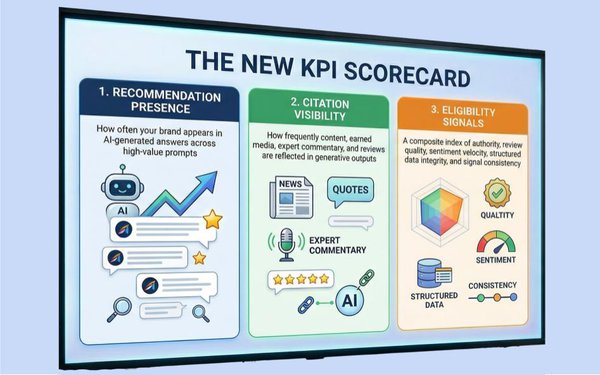
A new set of metrics and operational levers defines success in the AI era:
- Recommendation Presence: How often does your brand appear in AI-generated answers for high-value prompts?
- Citation Visibility: How frequently are your content, media mentions, and reviews cited in generative outputs?
- Eligibility Signals: A composite of authority, review quality, sentiment velocity, data integrity, and consistency.
These indicators can now be tracked through prompt monitoring, AI visibility audits, and sentiment analysis tools. Over time, they may become as critical as CPA and ROAS in measuring marketing effectiveness.
To build a resilient system, brands should focus on five interconnected levers:
- Authority as Stored Energy: Influencer endorsements and authoritative content shape category perceptions, feeding into the AI’s knowledge base and increasing selection probability.
- User-Generated Content (UGC) and Social Signals: Healthy reviews and community sentiment act as growth infrastructure, amplifying both reputation and media efficiency.
- Navigation from Search to Selection: While SEO remains foundational, strategies like Answer Engine Optimization (AEO) and Generative Engine Optimization (GEO) prioritize inclusion in AI syntheses over mere visibility.
- Data Integration: Leveraging first-party data, customer data platforms, and interoperable analytics enables brands to coordinate media, product, and customer experience for maximum performance.
- Measurement Beyond Clicks: As click-based attribution wanes, advanced modeling and incrementality testing help marketers understand what drives eligibility and selection, even when traditional metrics disappear.
Implications for Marketing Leadership
The rise of AI in digital marketing means that growth increasingly depends on a brand’s ability to earn recommendations through credibility and trust. Investments in branding and upper-funnel activities are no longer just about awareness; they are structural drivers for inclusion in AI recommendations. Brands that focus on building robust demand infrastructure and consistently emitting strong credibility signals will win in this new paradigm. In the AI-driven answer era, the winners are not the most aggressive bidders, but those who ensure both AI and consumers select them, rebuilding the growth engine in real time for lasting success.
This article is inspired by content from Original Source. It has been rephrased for originality. Images are credited to the original source.